HRV Analysis in Practice: Lessons Learned in Q2 – Heat, High-Tech & Heart-Related Questions in the HRV Consultation
A virtual space, enthusiastic HRV experts, and a wealth of fascinating datasets—all under the scientific guidance of Dr. Alfred Lohninger: Three high-caliber HRV “Jour Fixe” sessions took place during the second quarter. Despite the summer heat, there was plenty of intense intellectual engagement, as the real-world cases presented during the HRV consultation hour offered deep insights into the fascinating nuances of the autonomic nervous system (ANS).
In addition to in-depth medical analysis, these sessions also provided ample opportunity to address practical questions regarding handling and successful market positioning. Here are the key highlights, takeaways, and practical tips from our recent gatherings prior to the summer break:
Generational Check: HRV Challenges for Young and Old
One topic addressed during the second-quarter HRV consultation was the differences between age groups—both physiological and in terms of measurement.
- Challenges with older adults: We highlighted that erroneous readings occur more frequently in this group, potentially necessitating more intensive software filtering. Age-related skin dryness impairs conductivity, often preventing accurate detection of ECG R-waves and leading to artifacts. A practical tip here is to moisten the skin or electrodes; this applies to both ECG and chest strap measurements.
- Challenges with younger people: In children, the variability of HRV data is greater than in adults, and getting them to accept wearing a chest strap or ECG monitor for hours can be a hurdle. From the teenage years onwards, however, wearing the device is usually unproblematic.
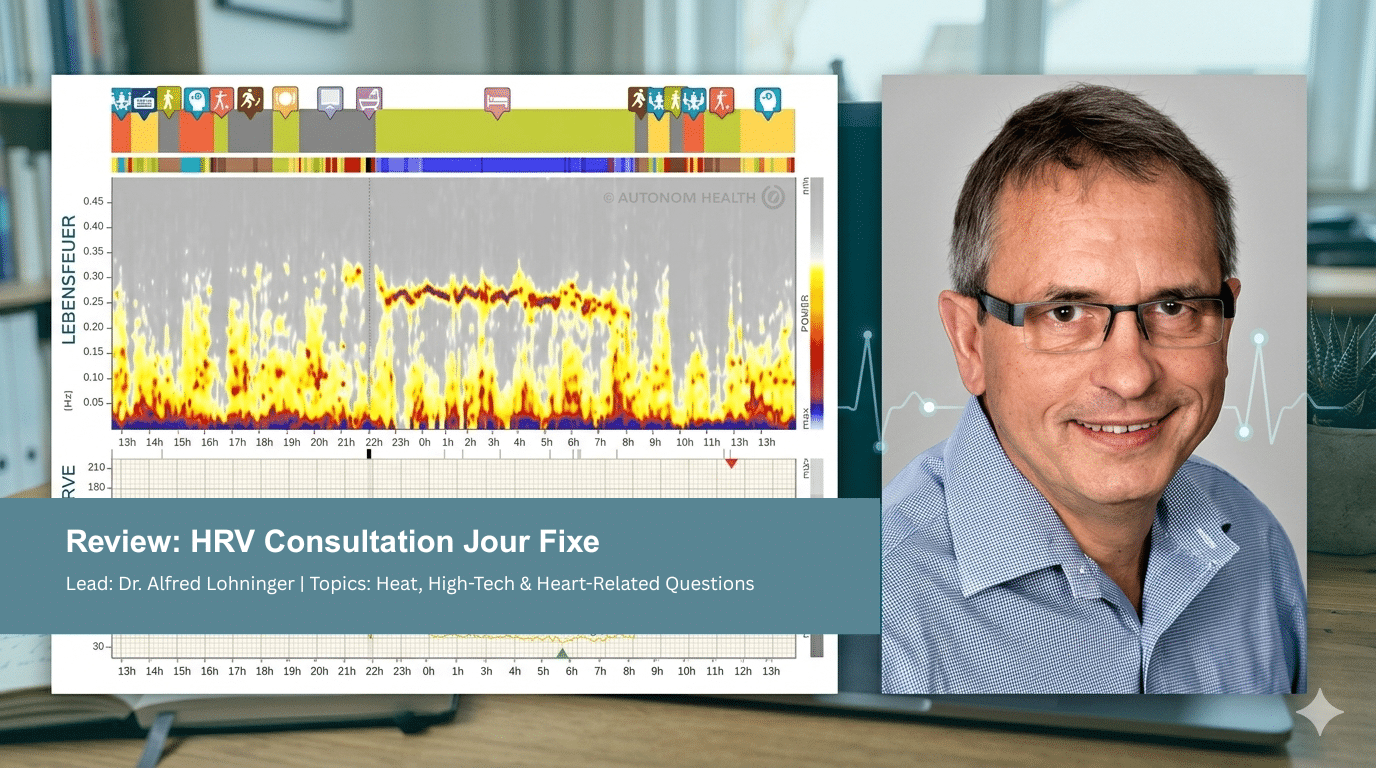
- The reward—beautiful sleep architecture: When a measurement is successfully obtained from a younger person, the result is often a brilliant “Lifefire“! It reveals flawless sleep architecture—with a clearly defined sequence of sleep phases—superb respiratory sinus arrhythmia (RSA), and a physiologically rapid respiratory rate of 17 or 18 breaths per minute (a rate that can actually be higher during sleep than during quiet wakefulness during the day).
Practical tip: Handling the HRV recorder & “blind” diagnostics?
A key topic during the exchange of experiences was the correct execution of measurements using the HRV recorder. Precise correlation of the measurement data with the activity log is essential for a comprehensive interpretation. Only when the client accurately documents their activities (sleep, exercise, meals, work) can the “Life Fire” be deciphered in detail.
In this context, an intriguing question arose: Is it actually possible to provide a well-founded recommendation without any prior knowledge of the individual? The clear answer is: Yes! Simply by analyzing the distribution of frequency bands (HF, LF, VLF) in conjunction with the activity log, one can precisely assess the regulatory capacity of the autonomic nervous system—even without knowing the client’s life history beforehand. HRV does not lie.
A Mathematical Look at HRVmed: Demystifying “Double RSA”
One case attracted particular attention: a subject exhibited extremely strong RSA and exceptionally high heart rate variability, alongside a substantial 73,000 heartbeats over a 24-hour period. However, a peculiar phenomenon was noted in the system: an apparent “double RSA.”
A close inspection of the tachogram and scatterplot confirmed that everything was perfectly normal. The solution to the mystery lies in a purely mathematical phenomenon: when RSA is extremely pronounced and various biological rhythms overlap, the calculation produces this visual effect in the diagram—a sign of a highly developed, highly flexible nervous system, and certainly no cause for concern!
A note on nighttime VLF: In this context, we also observed very high VLF (Very Low Frequency) values. If these occur at high levels during the night, one should be cautious about inferring psycho-emotional stress from them; often, the underlying cause is simply thermoregulation (especially in summer!) or hormonal processes..
Long Covid, ME/CFS, and the Microbiome: Giving the Body What It Needs
Another major topic was the condition following Long Covid and the question: Can ME/CFS (Myalgic Encephalomyelitis/Chronic Fatigue Syndrome) be detected in HRV readings?
Yes, the exhaustion profile effectively burns itself into the body’s vital energy reserves. A drastic reduction in HRV often appears even during moderate household chores—a clear sign of the phenomenon known as post-exertional malaise (PEM). We also frequently observe autonomic dysregulation—specifically, an excessive rise in heart rate upon standing, likely a compensatory mechanism for orthostatic dysregulation.
- Therapeutic approach: Alongside diagnostic and therapeutic methods such as autologous blood purification (apheresis), microbiome imbalance following Long Covid is increasingly coming into focus. The guiding principle here is to provide the body—at a biochemical level—with what it needs to function again at all (e.g., through targeted microbiome restoration and micronutrients).
- Polyvagal support: Targeted sympathetic nervous system activation has proven effective in patient care. When the “posterior vagus” (dorsal vagus) is locked in a “freeze” state, “Tiger Therapy” helps. Ultra-short, high-intensity physical stimuli signal to the system: “The danger has passed; you can let go of the ‘freeze’ (feigned death) reflex.”
Customer Acquisition & Marketing: How do I successfully position HRV analyses?
How do you introduce HRV analysis to a wider audience? Many colleagues are already successfully using the tool in the B2B sector. Seminars, corporate projects (workplace health promotion), and collaborations as a business coach serve as perfect levers for marketing and client acquisition.
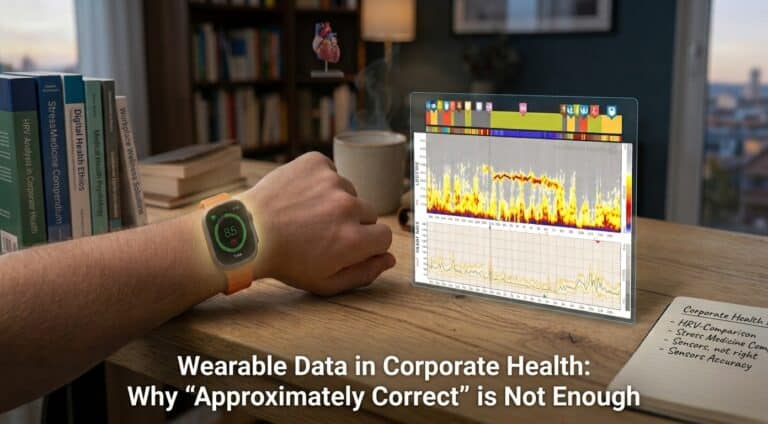
During sales conversations, the question frequently arises: “Why do I need a professional HRV measurement when I already have a smartwatch or an Oura Ring?” The unbeatable argument here lies in measurement quality: while consumer wearables typically measure HRV only intermittently—using optical sensors (PPG) and primarily during sleep—a medical-grade HRV recorder provides a highly precise, continuous, long-term ECG over a 24-hour period. Only in this way do the true dynamics of daily life, precise sleep architecture, and respiratory phenomena (such as the RSA described above) become visible and therapeutically actionable.
Heading into the summer break!
With these fascinating insights, we are now heading into a well-deserved summer break. We would like to thank all participants for the excellent exchange of ideas, the intriguing cases, and the productive discussions over the first two quarters.
We are taking this time to recharge our own vagal energy and are already looking forward to the next HRV Jour Fixe in the autumn! Enjoy the summer, stay regulated, and see you soon!
Conclusion: This exchange demonstrates how dynamic and complex HRV work is in everyday practice. We’re already looking forward to the next meeting! It’s always at 7 pm on the last Thursday of every month! (Currently only available in German. You can get the Zoom link for free participation by emailing office@autonomhealth.com.
HRV-Analyse & Portrait Dr. Alfred Lohinger: © Autonom Health Gesundheitsbildungs GmbH
Graphic design: Created with the support of AI (Gemini/Google)