Medical Cyber-Physical Systems: When Health Data Begins to Understand Humans
Cyber-physical systems (CPS) have long since become a part of our world. They combine physical processes with digital sensors, intelligent software, and automated control. In modern medicine, for instance, we encounter such systems in the form of smart insulin pumps, adaptive pacemakers, remote patient monitoring systems, and high-precision surgical robots.
However, the closer technology operates to the human body, the more apparent a fundamental problem becomes: the human organism cannot be controlled like a machine. It does not function based on rigid input and output variables.
The gap between measured value and reality
An elevated heart rate is a prime example of this. It could mean that someone is climbing stairs, is under immense stress, has had too little sleep, or is fighting off an infection. Equally, it could be a sign of sheer anticipation or profound exhaustion.
The same applies to heart rate variability (HRV): a single night of low readings might simply be a reaction to an intense day-or the first signal of emerging chronic dysregulation.
The significance of any given data point depends on countless variables: age, gender, time of day, current activity, and individual medical history. Consequently, medical CPS require far more than just high-quality sensors and a stable data connection; they need a layer for physiological interpretation.
This is precisely the point where Autonom Health’s technology comes into play.
From an isolated measurement to actual regulatory processes
Autonom Health does not view vital signs in isolation. The technology reveals how a person responds to stressors over a full 24-hour period, how they mobilize energy, the depth of their recovery, how they sleep, and how smoothly they transition between different biological states.
The foundation for this is high-resolution, long-term measurement of heart rate variability, combined with specific activity and contextual data. This creates not merely a static snapshot of the current state, but a dynamic functional profile of the autonomic nervous system within the context of everyday life.
This is the crucial point for the medicine of the future: health is not measured by the
rigid adherence to fixed standard values. It is revealed in the organism’s flexibility – in the
ability to respond appropriately to demands and subsequently return reliably to a
state of recovery.
Context turns data into actionable knowledge.
Modern wearables and medical devices effortlessly collect vast amounts of data today. Yet the bottleneck is no longer data acquisition, but rather the interpretation of that data:
- What does this specific deviation mean for this particular individual?
- Is it a normal, temporary adaptation, or a persistent problem?
- Is the physical reaction actually appropriate for the situation at hand?
- Does the body manage to switch to recovery mode after the exertion?
- And what measure will truly help the system as a whole at this point?
To this end, Autonom Health draws upon a foundation comprising over 70,000 quality-assured 24-hour HRV datasets, age- and gender-specific reference values, and a detailed classification system of physiological states.
In doing so, the system acts as a translator within a medical CPS: it bridges the gap between raw biosignals and their medical significance, between mere measurement and concrete action-in short, between technical precision and biological reality.
From pure monitoring to adaptive support
The next generation of medical cyber-physical systems will no longer be limited to sounding an alarm when a threshold is exceeded. It will need to continuously assess the body’s actual resilience and adaptability at any given moment.
For example, such a system recognizes:
- whether exercise at any given moment provides a positive training stimulus or completely overwhelms the body,
- whether sleep actually recharges one’s batteries or merely amounts to physical immobility amidst persistent high internal tension,
- and exactly when the right time for a therapeutic intervention is.
This opens up entirely new possibilities in key areas of care:
- Prevention & personalized lifestyle medicine: Targeted management of strain and recovery.
- Remote patient monitoring: Early detection of adverse changes in the home environment.
- Digital therapeutics (DiGA) & cardiometabolic care: Objective monitoring of progress.
- Women’s health: Consideration of cycle-related and hormonal regulatory differences.
- Rehabilitation & return-to-work: Safe, physiologically guided reintegration.
- Stress & exhaustion diagnostics: Objectification of burnout processes and overreaching.
- Clinical research: Continuous, real-world data basis for studies.
In doing so, Autonom Health does not rely solely on algorithms. Behind the platform lie
decades of medical practice, scientific networks, field-tested concepts, and
an ecosystem of over 1,000 certified HRV professionals.
A human being is more than the sum of their data.
An outstanding medical cyber-physical system is not defined by the sheer volume of data it generates. Its quality is revealed by how well it comprehends the human being behind the numbers-as a living, highly dynamic system that responds individually. Autonom Health provides the crucial element for this: an understanding of human regulatory capacity in real-life situations.
For medical technology manufacturers, providers of wearables, digital health platforms, and innovative healthcare architects, this opens up a clear strategic advantage: existing hardware and digital infrastructure can be enhanced with physiological intelligence that has matured over years-without having to reinvent the wheel.
The future of medical cyber-physical systems does not begin with even more sensors. It
begins with finally understanding what the body’s signals are trying to tell us.
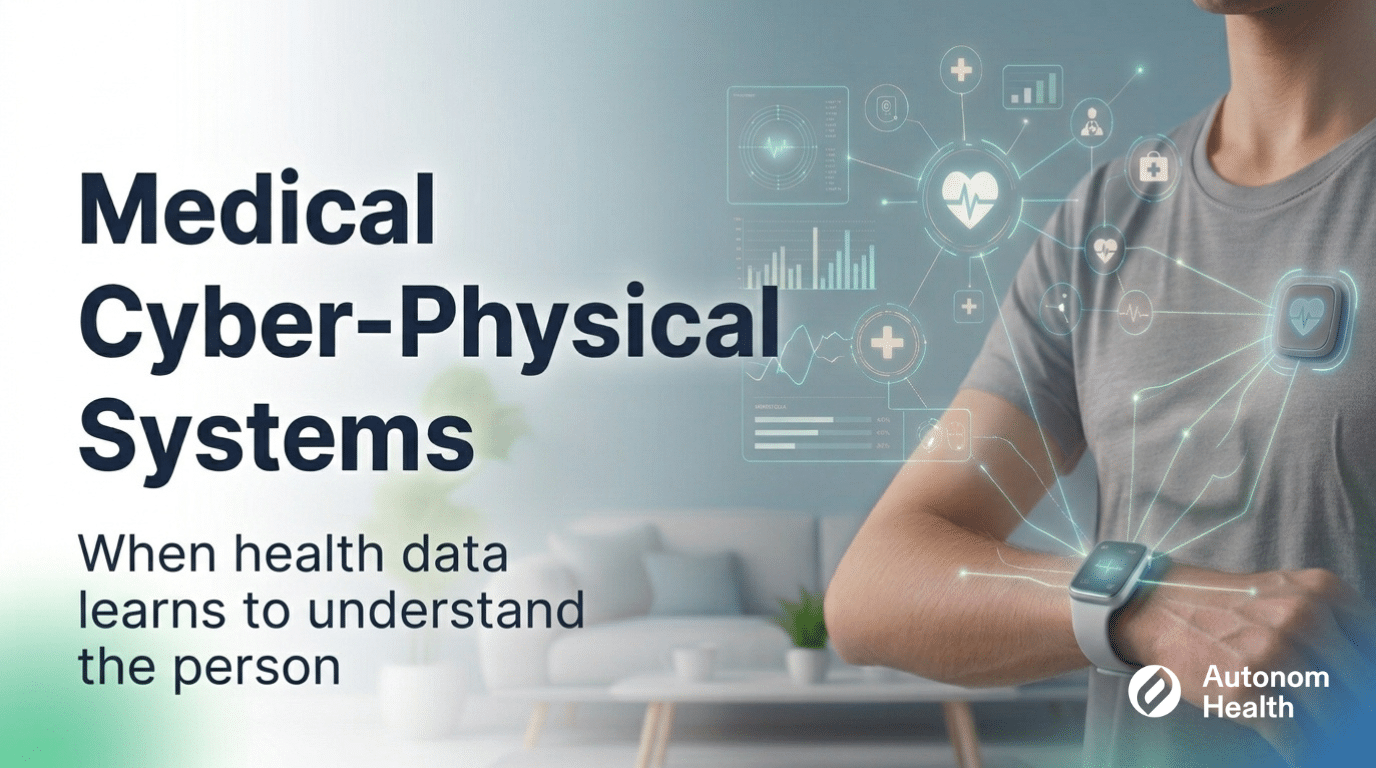
Image: Representative image (created with the assistance of AI / Google Gemini, incorporating brand elements) | © Autonom Health