HRV Analysis in Practice: Lessons Learned from the First HRV Consultations in 2026 – A Retrospective
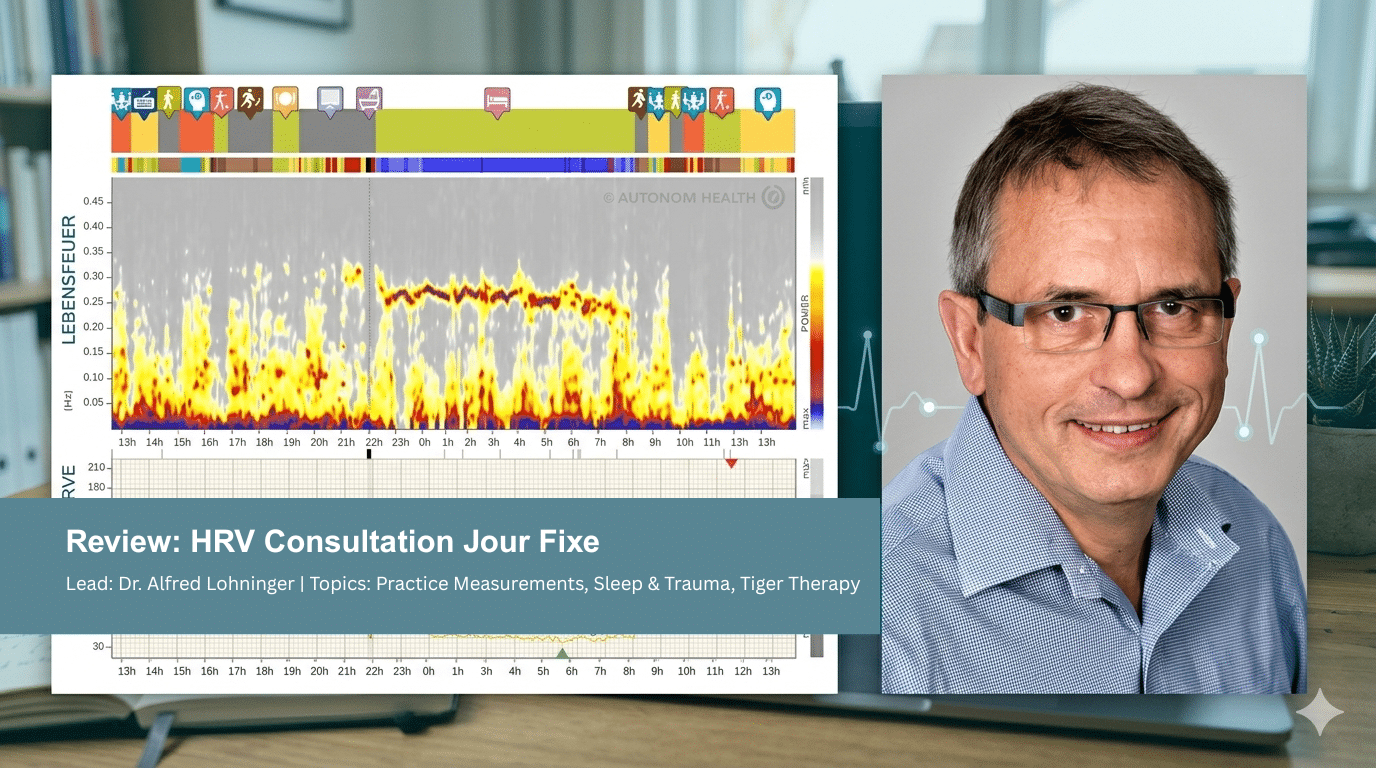
Since January, we have already held three of our new HRV “Jour Fixe” sessions—and the response has been fantastic! Led by Dr. Alfred Lohninger, around 15 participants gather in our virtual space for each session. It is especially great to see a valuable mix of seasoned experts and brand-new faces coming together.
What is discussed? Everything related to HRV analysis in practice. Here are the highlights and key takeaways from the first few sessions:
Getting Started with HRV Practice
A major topic was getting started with training and working with clients. Alfred’s clear advice: begin your own experiential practice as early as possible! You best understand the dynamics of the autonomic nervous system (ANS) when you take the measurements yourself. Make use of the community for feedback on your initial measurements—that is what this space is for.
HRV Interpretation: Sleep Quality, Trauma, and the ‘False’ High Vagal Tone
We have explored the frontiers of HRV analysis in depth:
- Snoring & sleep quality: When is action required? Assessing subjective sleep quality as part of a detailed medical history (weight, alcohol consumption, etc.) is crucial here. If abnormalities are detected, the next steps involve a referral to an ENT specialist or a sleep lab (keywords: sleep apnea/CPAP mask).
- Respiratory stress & trauma: We discussed how trauma-related disorders can manifest in the measurements. Respiratory stress often has the greatest psycho-emotional impact and requires a particularly sensitive approach. Exhalation—that is the key factor.
- The “false” high vagal tone: A seemingly high vagal value does not always indicate optimal recovery; it can also signal a “freeze” response.
Stress Regulation with Tiger Therapy: The Biological Reset for the ANS
A highlight was the discussion on “Tiger Therapy.” Our system often still operates with a Stone Age mindset: the saber-toothed tiger (stress) appears, and our instinct is to flee.
The solution: Engage the body! Act in short, intense bursts—specifically, ultra-short, high-intensity intervals. This signals to the body: “The tiger is gone.” Afterward, consciously shift into recovery mode: let your body feel heavy in the chair, exhale, and let go. It is the ultimate reset for the autonomic nervous system.
The HRV Triad: Why Context Is Everything
A central point of our discussion was the triad model: stimulus – stimulus processing – constitution. In HRV analysis, we consider not only the raw value, but also the interplay of these three pillars:
- The stimulus: What external factors are at play? (Job stress, training, heat, infection).
- The stimulus processing: How is the autonomic nervous system reacting to this at the moment? Here, real-time HRV measurement provides us with information about current adaptability.
- The constitution: The client’s biological “starting capital” and long-term condition. Age, genetics, and lifestyle form the foundation upon which stimulus processing takes place.
Only when we combine all three factors in the consultation do we understand why a modern “saber-toothed tiger” leads to a healthy adaptation in person A, while person B already slips into exhaustion mode.
Medical Borderline Cases & Technology
- Cardiology: When should clients be referred to a specialist? We discussed clear criteria for cardiac arrhythmias, noting that premature beats (extrasystoles) are often simply a sign of adaptation processes. When interpreting the measurements, it’s also important to review the scatter plot and tachogram in HRVmed.
- Chest strap influence: What should be done when clients say, “That wasn’t a normal day; the strap bothered me”? We discussed how to weight this subjective influence in the evaluation.
- Sports check: The step value was analyzed based on several sports measurements (including a reference to our HRVsport brochure).
Conclusion: This exchange demonstrates how dynamic and complex HRV work is in everyday practice. We’re already looking forward to the next meeting! It’s always at 7 pm on the last Thursday of every month! ((Currently only available in German. You can get the Zoom link for free participation by emailing office@autonomhealth.com.
HRV-Analyse & Portrait Dr. Alfred Lohinger: © Autonom Health Gesundheitsbildungs GmbH
Graphic design: Created with the support of AI (Gemini/Google)