The Missing Interpretation Layer in Digital Health
From Health Data to Physiological Intelligence
For years, digital health has concentrated on measurement.
Wearables now capture heart rate, activity, sleep and recovery with remarkable precision, and the sensors improve from one generation to the next. Apple, Microsoft, Google, Oura, WHOOP etc. have achieved something medicine never managed at this scale. They have made millions of people pay attention to their own physiology every day.
But health is not a collection of measurements.
Health is the capacity of a living system to regulate itself: to adapt to changing demands, recover after strain, and regain balance without losing flexibility.
So the next frontier is not another sensor. It is understanding what the data means.
We argued recently that “approximately correct” stops being good enough once wearable data
informs decisions in corporate health. This article is the structural answer to that problem.
From measurement to meaning
Heart rate variability (HRV) is the clearest example.
HRV opens a dynamic window into human regulation. It shows how the organism responds to stress, recovery, sleep, movement, emotion and changing demand.
But HRV is not one number.
The same value may indicate healthy recovery in one person, reduced activation in another, and physiological exhaustion in a third. Its meaning depends on age, sex, individual baseline, activity, time of day, recording quality, and above all on the pattern in which it occurs.
A living organism cannot be understood from an isolated value. It has to be read in context, and over time.
That is the challenge facing an industry now rich in physiological data and still poor in shared physiological meaning. How do we turn billions of measurements into information a professional can actually trust?
At Autonom Health we have worked on that question for more than twenty years.
Why the same physiology yields different answers
Every major platform now treats HRV as central to a complete picture of health. Yet the same person, on the same morning, can receive a different assessment depending on which engine reads the signal.
The foundations are not in dispute. The 1996 Task Force of the European Society of Cardiology and the North American Society of Pacing and Electrophysiology set the standards, and they remain the scientific reference. Under them, the clinical gold standard for HRV is the electrical R-R interval, captured by electrocardiogram.
Everything after that is where platforms diverge. How the signal is filtered. Which artefacts are removed, and which are mistaken for physiology. Which parameters are computed, which reference population they are measured against, and how all of it is condensed into a single recommendation.
Those choices decide the answer. They are also the part the industry publishes least. Sensor validation studies are common and often excellent. Published interpretation methodology is rare.
That is the gap. The sensors are excellent. The step between the signal and the recommendation is where the problem sits.
The interpretation layer
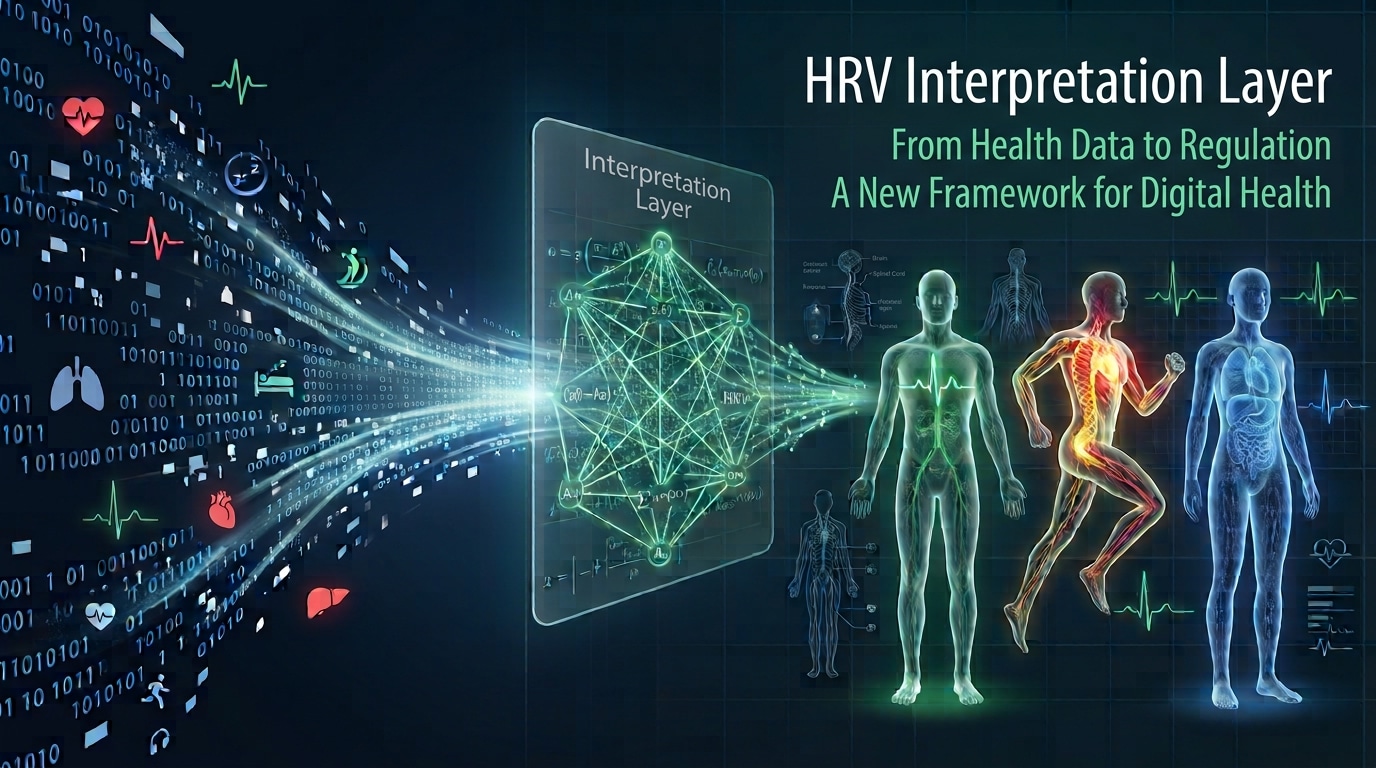
Digital health needs a distinct layer between physiological measurement and the insight shown to the user. Not another Wearable, Not another closed score, but a physiological interpretation layer.
In practice it works like this. The layer takes in beat-to-beat interval data, from high resolution 24 hour ECG recordings and from compatible third party sensor streams. It assesses signal quality explicitly, separating physiological change from measurement noise. It computes parameters and patterns, measured against individual baselines and normative data differentiated by age, sex and activity. It returns those parameters with their derivation documented, rather than a single number whose origin is proprietary.
Measurement quality, physiological interpretation and recommendation stay separate and visible.
That separation is the whole point. A closed system tells you what it concluded. A documented one lets you see why.
The standard that digital health is still missing
Medicine depends on standards. When a physician interprets blood pressure, glucose or an ECG, they rely on defined measurement procedures, reference ranges and a shared clinical language. Without that common ground, values from different systems cannot be compared, and they cannot be turned into responsible decisions.
HRV has its foundation in the 1996 report, and its principles hold. What that report could not anticipate was continuous measurement on the wrist, wearable ecosystems at population scale, and physiological AI. The technology moved. The shared interpretative framework did not move with it.
We have spent two decades building on that foundation: artefact detection, contextual 24 hour analysis, age and sex specific reference values, activity and circadian patterns, and the translation of individual parameters into recognisable physiological states.
The market has no shortage of new HRV scores. What it lacks is a common framework that lets HRV data from different devices be interpreted consistently and transparently.
So our next goal is larger than another product. Together with European universities and scientific partners, we want to help lay the foundations of a contemporary HRV standard, one built for ECG, wearables and physiological AI alike.
Twenty years is the part that cannot be accelerated
Sensors improve quickly. Physiological knowledge accumulates slowly, and differently.
Behind our work sits:
- more than 2.2 million hours of ECG measurement
- 41 million health index records
- more than 30,000 individual users
- more than 1000 professional partners applying the analysis in clinical, occupational and performance settings
A reference population cannot be produced by an engineering sprint. It grows through years of careful measurement, real application, and scrutiny from people who will say so when it is wrong. Hardware can be built. An interface can be redesigned. A model can be retrained. Physiological intelligence has to be accumulated.
Knowledge also has to leave the company that holds it. That is why education has been part of our work from the start. Through the Autonom Health Academy we teach HRV well beyond the boundaries of our own software, and we wrote the practice textbooks the field uses.
The more professionals understand how an interpretation is derived, the more responsibly the technology gets used.
Device independent by design
The future of digital health will not belong to a single sensor.
Apple, Samsung, Garmin, Oura, WHOOP and others are producing physiological data of a quality and continuity that was unimaginable ten years ago. That is good for the whole field.
The opportunity is to make physiological intelligence portable across those ecosystems rather than trapped inside any one of them.
A neutral interpretation layer sits above the hardware. Different sensors contribute data, and one consistent framework translates it into physiological meaning. Periodic high resolution ECG provides an individual reference map, and continuous wearable data can then be read against that map. Everyday accessibility, with physiological depth underneath it.
The sensor measures, the platform collects, the interpretation layer creates meaning.
From observing health to learning regulation
Understanding physiology is not where this ends. The point is to help people regulate.
Read in context, the data shows not only that something changed but how the organism responded. Is the person activating appropriately, or still mobilised long after the demand has passed? Is sleep producing real recovery? Is training strengthening regulation, or quietly adding to the load? Is a lower HRV a passing response, an individual pattern, or the early part of a longer decline? And which intervention, whether breathing, movement, recovery or a change in sleep timing, actually improves that person’s regulatory capacity?
This is where digital health becomes health competence. The person is no longer only observed. They begin to understand their own organism, and to act on it.
Why transparency will matter
As physiological AI becomes more capable, transparency matters more, not less.
This is more than a philosophical preference. The transparency obligations of the EU AI Act entered enforcement in August 2026, with further requirements for certain high risk employment applications scheduled to follow.
Where an automated assessment can materially affect health, employment or access to essential services, an organisation will have to show what was measured, how quality was assessed, how the interpretation was reached, and where it stops being reliable.
We set those requirements out in detail in our recent article on wearable data in corporate health. They weigh more heavily still when an interpretation may influence medical advice, an occupational decision or an insurance assessment.
One of them is the easiest to lose, so it is worth restating. The individual must keep sovereignty over their own physiological data. A system that is transparent to professionals but opaque to the person measured has solved half the problem.
Transparency is not the enemy of sophisticated technology. It is what makes sophisticated technology usable in a responsible health system, and it is very hard to retrofit into a system that was not designed for it.
Complement, not compete
Our ambition is to complement the world’s leading sensors and health platforms, not to compete with them.
Autonom Health can provide a neutral, scientifically grounded interpretation layer for any platform that wants physiological depth without recreating two decades of HRV research, reference data and professional practice.
For a platform with world class sensing, scale, a serious privacy architecture and a daily relationship with the user, that opens a next step: moving from showing people what changed to helping them understand how their body is regulating, and what they can do about it.
Because the future of digital health is not about collecting more data. It is about understanding the human being as a dynamic, self regulating system.
The most important technology in that future may not be the sensor on the wrist. It may be the intelligence that turns its data into understanding, and understanding into the capacity to regulate.
Dr. Alfred Lohninger
Founder, Autonom Health
Reference: Task Force of the European Society of Cardiology and the North American Society of Pacing and Electrophysiology. Heart rate variability: standards of measurement, physiological interpretation, and clinical use. Circulation 1996;93(5):1043–1065. Also published in European Heart Journal 1996;17:354–381.
Image: Symbolic image (created with AI support / Google Gemini, incorporating brand components) | © Autonom Health