Wearable Data in Corporate Health: Why “approximately correct” is not enough
When health data has consequences, “approximately correct” is not enough.
Fitness trackers and smartwatches have revolutionized health awareness. They accompany people around the clock, highlight trends, and motivate them to pay attention to sleep, exercise, and relaxation.
However, the more relevant this data becomes to our lives, the greater the responsibility for its accuracy.
As long as a wearable device merely serves as a personal guide in everyday life, rough guidelines are usually harmless. The situation is completely different, however, when this data serves as the basis for decisions in workplace health management, prevention, or even insurance.
What happens when a health score no longer just reflects personal feelings, but decides on bonus schemes, tariffs or health services?
At this moment, data quality becomes a question of fairness.
Optical sensors vs. ECG precision
Consumer wearables typically measure heart rate optically at the wrist (PPG). Under optimal conditions – especially in complete rest or during sleep – this provides reliable everyday trends.
However, a medically sound 24-hour heart rate variability (HRV) study pursues a different goal. It records the heart’s electrical activity using an ECG throughout the entire day: at work, during stress, physical exertion, periods of rest, social interaction, and sleep.
The crucial difference lies not only in the sensor itself, but in the signal processing, artifact removal, and the depth of medical interpretation.
Uniform algorithms can quickly make data appear precise, even when it isn’t. Missing heartbeats, motion artifacts interfering with the measurement, or arrhythmias massively distort the HRV values. When flawed raw data is simplified and translated into a visually appealing score, the result is a mathematically accurate but physiologically inaccurate statement.
The most dangerous scenario in digital health is: inaccuracy in, convincing score out.
What responsible employee wellbeing requires
To ensure that health data provides real benefits in a business context without causing harm, clear standards are needed:
- Signal quality at ECG level: Transparent detection and correction of artifacts and measurement errors.
- Clear separation: A clear distinction between pure measurement value, physiological interpretation, and recommended course of action.
- Representative references: Comparison with validated age and gender norms from real populations.
- Contextual reference: Incorporating the actual daily and activity pattern instead of isolated average values.
- Transparency & logic: comprehensible calculation rules instead of opaque “black box” algorithms.
- Data protection & ethics: Full data sovereignty with the user, absolutely no insight for employers into individual values and protection against discrimination through misinterpreted data.
The solution: Connection instead of exclusion
For over 20 years, Autonom Health has been developing precisely this quality and interpretation logic. Our work is based on high-resolution 24-hour ECG measurements, more than 70,000 quality-assured long-term datasets with lifestyle protocols, and standardized reference data.
The aim is by no means to replace wearables. Their strengths, everyday usability, reach, and continuous feedback are undeniable.
The opportunity lies in the combination: A highly precise 24-hour HRV measurement serves as a periodic reference and calibration measurement. It physiologically interprets the continuous data from the wearable. In this way, we combine the convenience of consumer tech with the medical depth of ECG analysis.
Powered by Autonom Health: the interpretation layer for your platform
Wearables, wellbeing, corporate health and insurance platforms can integrate our physiological analysis through a single API. Your product, your interface, your brand, with a documented method behind the results that you and your customers can point to by name. Attribution is optional, but for regulated and professional buyers it is usually the point.
The future of digital health lies not in the choice between consumer wearables or medical measurements, but in their intelligent symbiosis.
Because the more noticeable the consequences of an analysis are for people, the more uncompromising the requirements for data quality, transparency and validity must be.
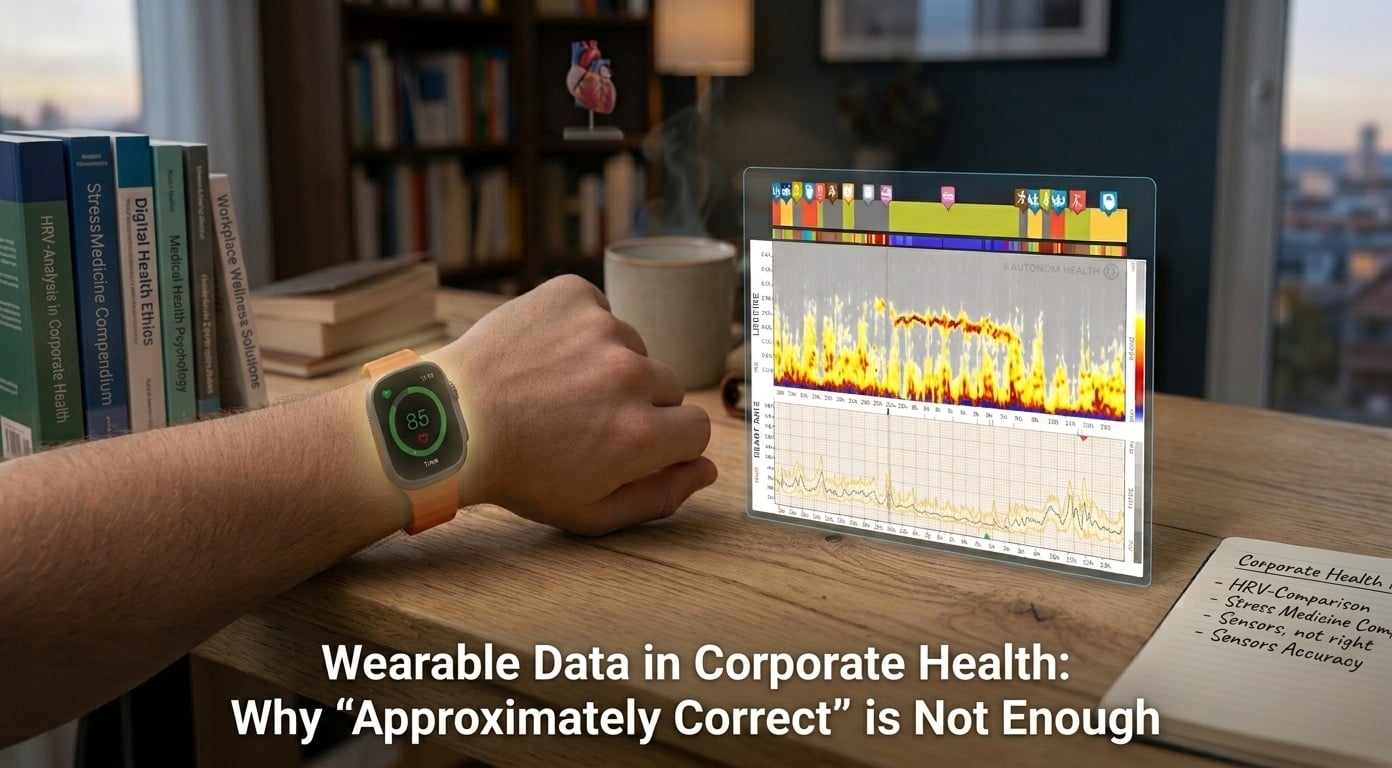
Image: Symbolic image (created with AI support / Google Gemini, incorporating brand components) | © Autonom Health